

You do not need a mythical mega-grant to balance next year’s budget. You need a focused plan that targets funders who like what you do, funds you at the size you can win, and moves with your team’s real capacity.
This roadmap shows how established 501(c)(3)s what it takes to build a 6-to-12-month grants program that raises awards while cutting internal time by 80% or more. It starts with private foundations, then brings in government grants only when you are ready and keeps leadership time under 2 hours per month.
Let’s zero in on the work that actually drives wins in FY27.
You don’t have to figure out grants alone.
With over $131 million in grants won, we know what funders are looking for. Our system lets you manage the grant writing process in less than 2 hours per month so you can focus on your mission, not your proposals. A free call takes 15 minutes and will show you exactly where to start.
Book Your Grant Game Plan → See what we’ve won for organizations like yoursWhat a Low-Burden, High-ROI Plan Looks Like
A high-ROI plan filters out low-fit opportunities before anyone writes a sentence. It concentrates on repeatable funders, fundable projects, and right-sized asks. In practice, that means:
- A ranked funder list of all your reasonable prospects built on fit, timing, and projected ROI
- A rolling 12-month calendar with 10 to 30 foundation submissions and 1 to 5 government shots only when prerequisites are locked
- Outsourcing research, drafting, and packaging to a senior team so your staff approves, signs, and stewards
- Quality control that mirrors actual reviewer score sheets
- Simple metrics that prove traction in 60 days, not 12 months
This low-burden plan, if done completely in-house, doesn’t take away the time it takes to write quality submissions.
Millionaire Grant Lady & Associates has written grants since 2008 and supported clients in cutting internal grant time by 80% or more, often to under 2 hours per month for private foundations, while improving proposal quality and competitiveness.
Prioritize Funders for Fit, Timing, and ROI
Although this differs from our proprietary framework, you need a way to assess where to submit proposals. You could do this using a 3-factor score for every prospect:
- Fit: Mission alignment, geography, population served, and gift size that matches your need.
- Timing: Known cycles, open windows, and realistic lead time for data, letters, and approvals.
- ROI: Average award size, match requirements, reporting load, and the likelihood of renewal.
Ready to accelerate the shortlist without burning hours in databases? A vetted private foundation search can fast-track a ranked pipeline with deadlines, giving history, and recommended ask amounts. You can learn more in our Private Foundation Search & Review.
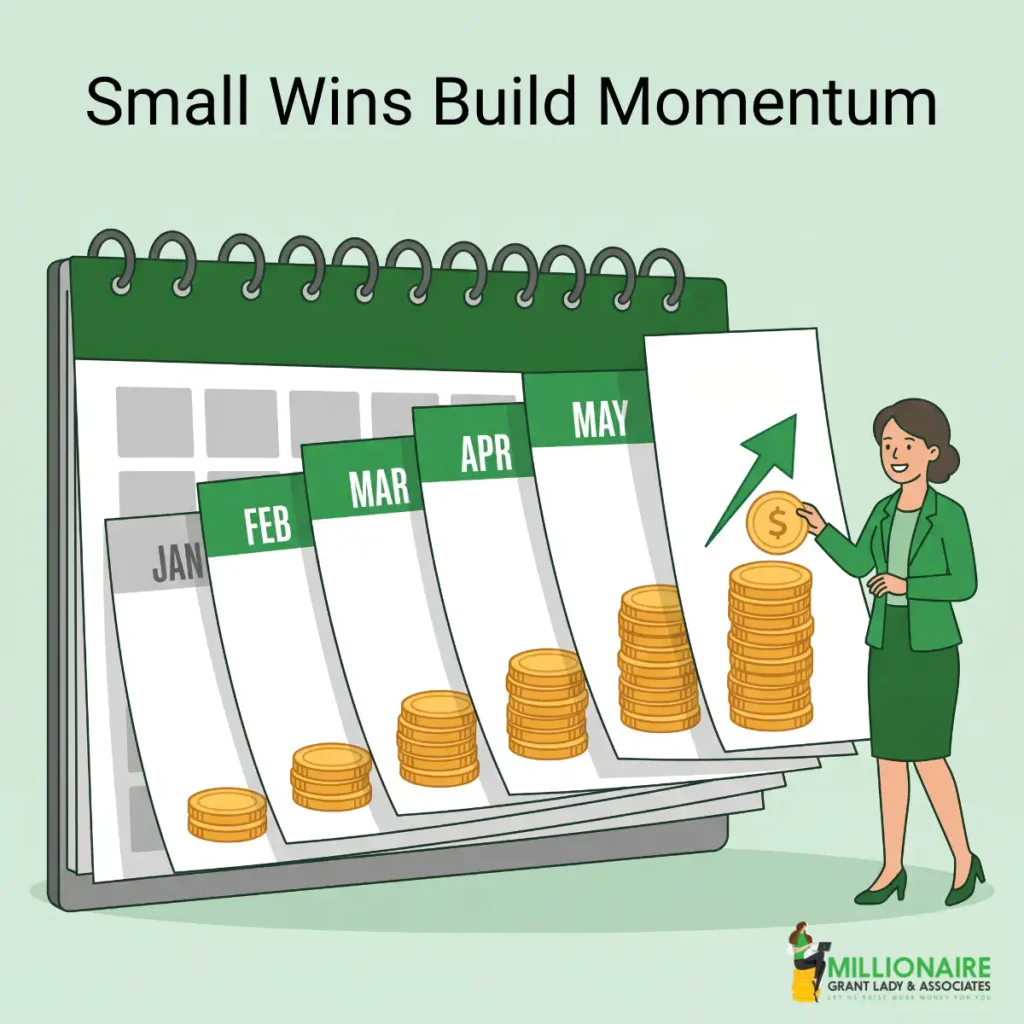
Build a Rolling Calendar that Accumulates Wins
Aim up to 5 private foundation submissions per month for 6 months, then sustain.
- Months 1 to 2: Submit 2 to 3 renewals or lapsed relationships first. Add 1 new high-fit foundation.
- Months 3 to 4: Add 2 to 3 new foundations in your geography with average awards that match your need. Steward any awards immediately.
- Months 5 to 6: Repeat what worked. If your readiness is strong, add 1 targeted local or state government grant with low match and clear scoring.
- Months 7 to 12: Maintain 1 to 2 submissions per month. Add federal only when prerequisites, partners, data, and budget models are in hand.
It can take up to 8 hours per submission. That doesn’t include managing relationships, researching prospects, or, everything else you have to manage within the organization.
If that sounds… unmanageable, book a call with Millionaire Grant Lady so we can take the heavy lifting off your hands. Our system lets you manage the grant writing process in less than 2 hours per month and reduce the cost of winning grants by up to 30%.
If you want curated government options without constant monitoring, use a tool that screens daily releases against your focus areas and flags realistic fits. Our team’s VIP Federal Grant Monitor filters opportunities like SAMHSA and HUD so you are not chasing noise.
Keep Staff Time Under 2 Hours Per Month
Your internal steps are short and scheduled:
- 15 minutes: Monthly go/no-go review
- 30 minutes: Single-source approvals for narratives, budget, and attachments
- 30 minutes: Stewardship check-ins and outcomes logging
- 15 minutes: Board or executive update on pipeline and wins
Everything else gets outsourced to a senior grant team (with a proven track record) who have the right tools, templates, and reviewer-informed processes.
What to Outsource vs. Keep In-house
Outsource these to reduce burden and lift quality:
- Prospect research and scoring
- Proposal drafting, budget translation, and forms. Writing is the most time consuming part.
- Compliance packaging, uploads, and submission
- Reviewer-informed edits and red-team reads
Keep these in-house to maintain voice, strategy, and relationships:
- Final program decisions and budget authority
- Funder meetings, site visits, and stewardship
- Data ownership and outcomes definitions
If you need bandwidth right now, book a call to discuss our Total Grants Management for an end-to-end lift, or Interim Grant Writing Support to bridge a staffing gap while keeping your calendar moving.
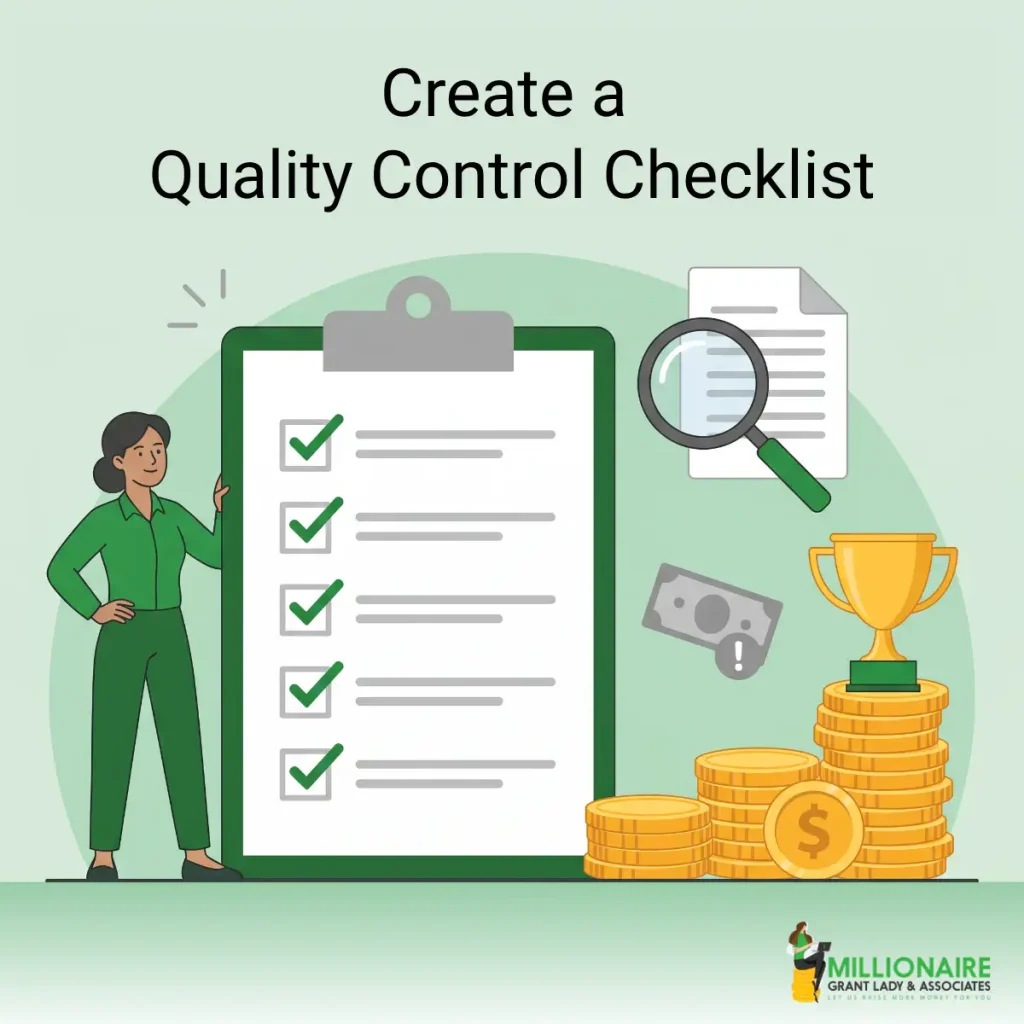
Quality Control that Mirrors Score Sheets
Reviewers score, they do not guess. Millionaire Grant Lady’s proprietary quality control system takes a page from NASA, resulting in an identified error rate of less than 1%. The only way to access that is by working with us, but you can start by calibrating your QC to mirror reviewers:
- Need and significance: Cite local data trends, target population, and gap your program fills. Tie to funder priorities.
- Approach and feasibility: Present a clear model, staffing, timeline, and service counts. Use a 1-page work plan.
- Evidence and outcomes: Define 3 to 5 measurable outcomes with baseline and data sources. Avoid vanity metrics.
- Budget and sustainability: Align dollars to activities. Explain post-grant funding and realistic renewal path.
- Organization and capacity: Summarize leadership, partners, and past outcomes that prove you can deliver.
Run a red-team review against these headings before submission. A specialized grant editing service can pressure-test alignment, clarity, and score coverage in one pass. If you want a fast readiness gut check, our Attractiveness Quotient assessment highlights credibility gaps that quietly cost points.
Metrics that Prove Your Program is Working
Track five signals monthly:
- Average award size: Aim for steady growth as you learn the range that fits you best.
- True staff time per submission: Total internal minutes across roles.
- Cycle time to submission: Days from go to filed. Shorter cycles show you are removing friction.
- Renewal rate: The percentage of funders who award you again. Renewals are your lowest cost wins.
Decide in advance what you will stop doing if a metric dips. For example, pause low-ROI new prospects if the renewal rate drops below your baseline.
FAQ: Quick Answers for Busy Leaders
- What does a low-burden, high-ROI plan look like? A ranked foundation-first pipeline, up to 5 submissions per month, reviewer-led QC, and metrics that guide go/no-go calls.
- How can we keep grants moving in under 2 hours per month? Outsource research, drafting, and packaging. Keep internal time to approvals, signatures, and stewardship.
- Which tasks should we outsource versus keep? Outsource prospecting, writing, and submission. Keep strategy, relationships, and final authority.
- How do we prioritize funders and build a rolling calendar? Score fit, timing, and ROI; prioritize the highest scores; schedule 10 to 30 foundation submissions; add government only when ready.
- Which metrics prove it is working? Rolling year ROI, average award size, true staff time, cycle time, and renewal rate.
Next steps for FY27
Want to see how our process can reduce internal time by 80% or more and improve proposal quality across private and government grant writing?
Start with a brief call. We will map your 90-day plan, identify 3 to 5 quick wins, and set up a calendar you can run in under 2 hours per month.
Ready to stop researching and start winning grants?
You’ve read the strategy. Now let someone who’s won over $131 million put it to work for your organization. Our Total Grants Management service takes less than 2 hours of your staff time per month.
A call is free, takes 15 minutes, and you’ll leave knowing exactly what’s possible for your nonprofit.
Book Your Grant Game Plan → See our track record firstGet Your Free Nonprofit Grant Calendar Template
Stop scrambling before deadlines. This template tracks application windows, board meetings, and reporting due dates in one place.
No spam. Unsubscribe anytime. We respect your inbox.