
AI-written grant applications fail because predictive-text tools produce average writing, and average proposals lose competitive funding. In a grading rubric we built based on 15 years of grant review, AI-generated applications have never scored higher than a D. Winning grants take human judgment plus rigorous, multi-layer quality control.
Let’s be honest about where you are.
You’re wearing five hats. You’re tired. And everywhere you look, somebody is promising that AI will write your grant applications in ten minutes, for free.
You don’t have to figure out grants alone.
With over $131 million in grants won, we know what funders are looking for. Our system lets you manage the grant writing process in less than 2 hours per month so you can focus on your mission, not your proposals. A free call takes 15 minutes and will show you exactly where to start.
Book Your Grant Game Plan → See what we’ve won for organizations like yoursI get the appeal. When you’re short on staff and buried in deadlines, a tool that drafts a proposal overnight sound like a lifeline.
So, I tested it. I built a “grant grader” — a rubric that scores an application the way a real reviewer would, using the same standards I’ve relied on across 15 years and more than $130 million in funding.
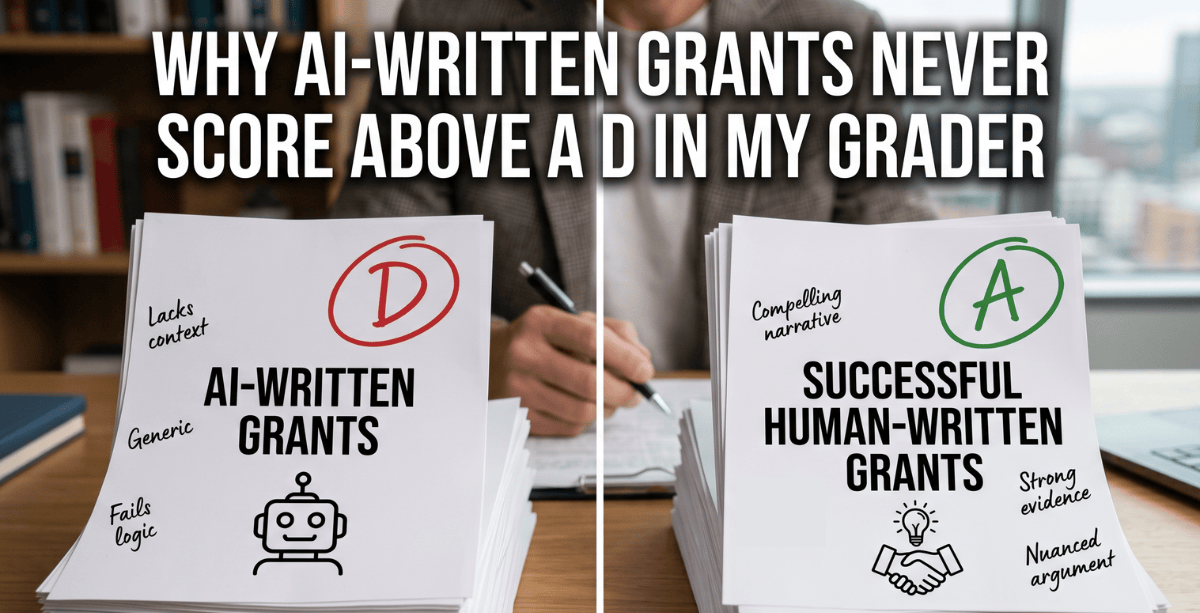
The AI-written applications never score above a D.
Not once.
Why “average” proposals lose
Here’s why AI writing tools fall short: AI is predictive text. Fancy autocomplete. It guesses the next most likely word based on the average of everything ever written on the internet.
Average is a big problem.
A grant is not a paper you turn in for a passing grade. It’s a competition. The reviewer is tired, reading their 20th application of the day, and looking for a reason to say no. When your proposal sounds average, you don’t stand out… you vanish into the stack.
That’s why AI earns a D in my grader.
It’s doing exactly what it was built to do: produce something that sounds fine. And “fine” does not win six-figure funding.
I’ve written more about where AI helps and where it sinks you: short version, it’s a great assistant and a terrible writer.
What we do instead: a page from NASA
I’m a little obsessed with NASA.
When the stakes are high enough that failure isn’t an option, NASA doesn’t lean on talent or hope. They lean on systems. Checklists. Redundancy. Someone checks the work, then someone checks the checker.
We run grant applications the same way.
Every application we submit goes through layers of quality control. Not just the big federal ones. Every single one. I don’t know anyone else in this industry who does this.
Here’s what that looks like:
We do the heavy thinking up front. Before a word of the application gets written, we work the planning and the core language until it’s right. We catch mistakes early.
Every application gets an AI check and a human check. Our review checklist has 6 sections and 37 items. Every application runs through it, more than once. AI flags what machines are good at catching. A human catches what machines never will.
It runs on real databases, not a chatbot prompt. We build a custom database for each client and maintain a library of quality-control measures we’ve developed across all of them. That’s institutional knowledge, captured and reused (not me typing a clever prompt into ChatGPT).
We use the data to get better. The databases show us where work slips, so we tighten the system over time. We are always adding new checks.
The result: an identified error rate of less than 1%.
What a sub-1% error rate buys you
You don’t need to memorize our 37-point checklist. Here’s what it means for you:
- Your application doesn’t get tossed for being boring or generic or missing an attachment.
- Your numbers match across every submission.
- The work that goes out under your name is the work of a CFRE-credentialed team with a proven track record (not a gamble on a rushed freelancer or a robot).
In funding, trust isn’t a nice-to-have. A funder who spots sloppy mistakes starts wondering what else you got wrong. A funder who can’t tell your work from the generic work of others based on boring writing will think of you as boring for a long time. Poor quality applications can cost you the relationship (and the next grant, too).
Our job is to make sure that never happens.
“Should I just use AI?” (My honest answer)
I’m not anti-AI. I built an AI checklist for each application. We use AI checks every day.
But I use it the way NASA uses a wrench: as a tool inside a system run by experts, not as the pilot.
AI can help you outline. It can boil a 60-page RFP down to a one-page brief. It can break writer’s block at 9 PM. Those are real, useful jobs.
What it cannot do is read the room with your program officer.
It doesn’t know your community.
And, per my own grader, AI can’t write an application that scores higher than a D.
You don’t have to choose between speed and quality
Our system lets you manage the grant writing process in less than 2 hours per month and reduce the cost of winning grants by up to 30%. Why? Because the system does the heavy lifting, so you don’t have to.
You get your evenings back. We get the details right.
Ready to hand the quality control to a team that treats it like a launch sequence? Book a call. You’ll feel like a million bucks — and you might just raise that much, too.
Key Takeaways
- AI-written grant applications score no higher than a D in our grader, because predictive-text tools produce average writing — and average loses competitive funding.
- Every Millionaire Grant Lady application passes through both AI and human quality control: a 6-section, 37-item checklist, run more than once.
- The process runs on custom client databases and a cross-client library of quality-control measures, not one-off chatbot prompts.
- The payoff is an identified error rate under 1%, which protects your credibility with funders.
- Use AI for outlining and summarizing — never for writing the proposal that decides your funding.
Ready to stop researching and start winning grants?
You’ve read the strategy. Now let someone who’s won over $131 million put it to work for your organization. Our Total Grants Management service takes less than 2 hours of your staff time per month.
A call is free, takes 15 minutes, and you’ll leave knowing exactly what’s possible for your nonprofit.
Book Your Grant Game Plan → See our track record firstGet Your Free Nonprofit Grant Calendar Template
Stop scrambling before deadlines. This template tracks application windows, board meetings, and reporting due dates in one place.
No spam. Unsubscribe anytime. We respect your inbox.