
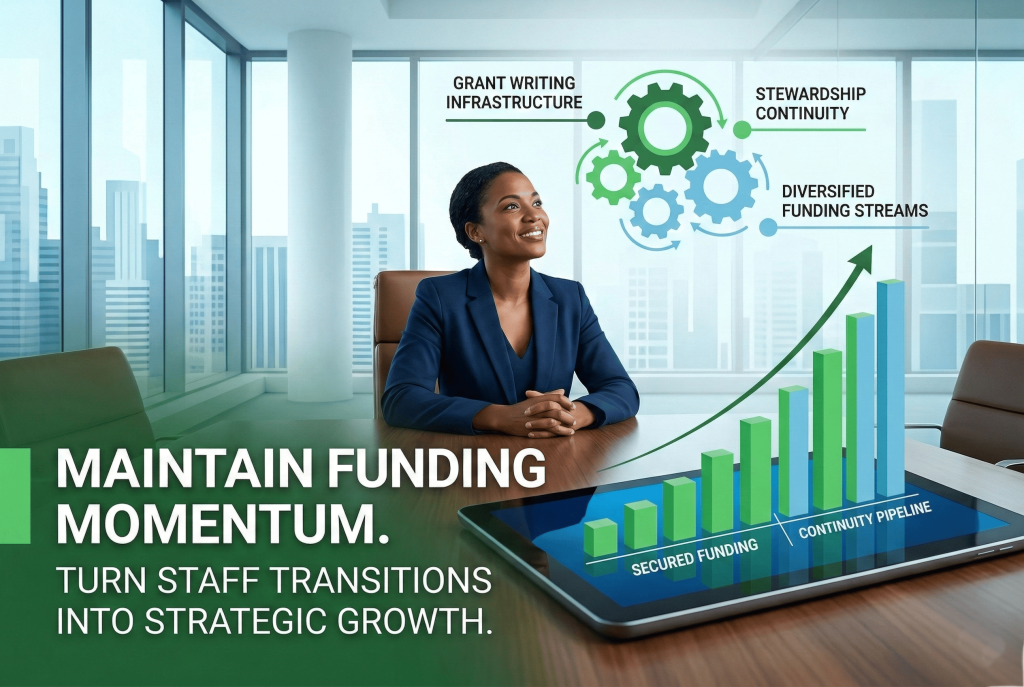
Interim grant writing support provides temporary, high-level expertise to manage a nonprofit’s funding pipeline during staff vacancies. This strategic intervention maintains stewardship continuity and prevents the significant financial loss associated with development director turnover.
At a Glance:
- Economic Impact: Replacing a fundraising specialist costs $127,650 in direct and indirect revenue loss.
- Strategic Framework: The Stewardship Continuity Model professionalizes the “Grant Toolbox” during transitions.
- Performance Metric: Organizations using fractional leadership can reduce grant acquisition costs by 30%.
Turnover is more than an HR headache; it is a revenue leak that can sink a nonprofit’s growth for years. Finding reliable interim grant writing support avoids a desperate act of crisis management after a staff departure creates a quantified $127,650 hole in your budget. This collapse in revenue momentum often forces Executive Directors into a “vicious cycle” where the mission stalls while waiting for a median 180-day vacancy to fill.
Elite organizations use fractional grant writers to maintain stewardship continuity while professionalizing their infrastructure. Securing over $125 million for our partners has taught us that staff transitions are the moments when your funding pipeline is most vulnerable to administrative decay. We reject the idea that turnover must mean dormancy. Instead, it is an opportunity to institutionalize your “Grant Toolbox” and strengthen your proven track record.
You don’t have to figure out grants alone.
With over $131 million in grants won, we know what funders are looking for. Our system lets you manage the grant writing process in less than 2 hours per month so you can focus on your mission, not your proposals. A free call takes 15 minutes and will show you exactly where to start.
Book Your Grant Game Plan → See what we’ve won for organizations like yoursLearn a proven roadmap for navigating turnover without losing your funding. By integrating a proven stabilization framework, you transform this leadership gap into a period of strategic growth.
Quantifying Fundraising Gaps During Vacancies
The cost of grant writer turnover is the total financial loss resulting from recruitment fees, onboarding time, and the gap in submission capacity. In 2026, the estimated replacement cost for a fundraising specialist is $127,650. This figure accounts for a 10% drop in donor retention and losing institutional memory during transitions.
A grant writing vacancy causes more than a missed deadline in terms of financial impact. Most boards focus on the saved salary, ignoring the kinetic loss of momentum. Research reveals that replacing a senior professional can cost between 150% and 200% of their annual salary, fully loaded. Besides administrative friction, it’s a direct hit to your programmatic scale.
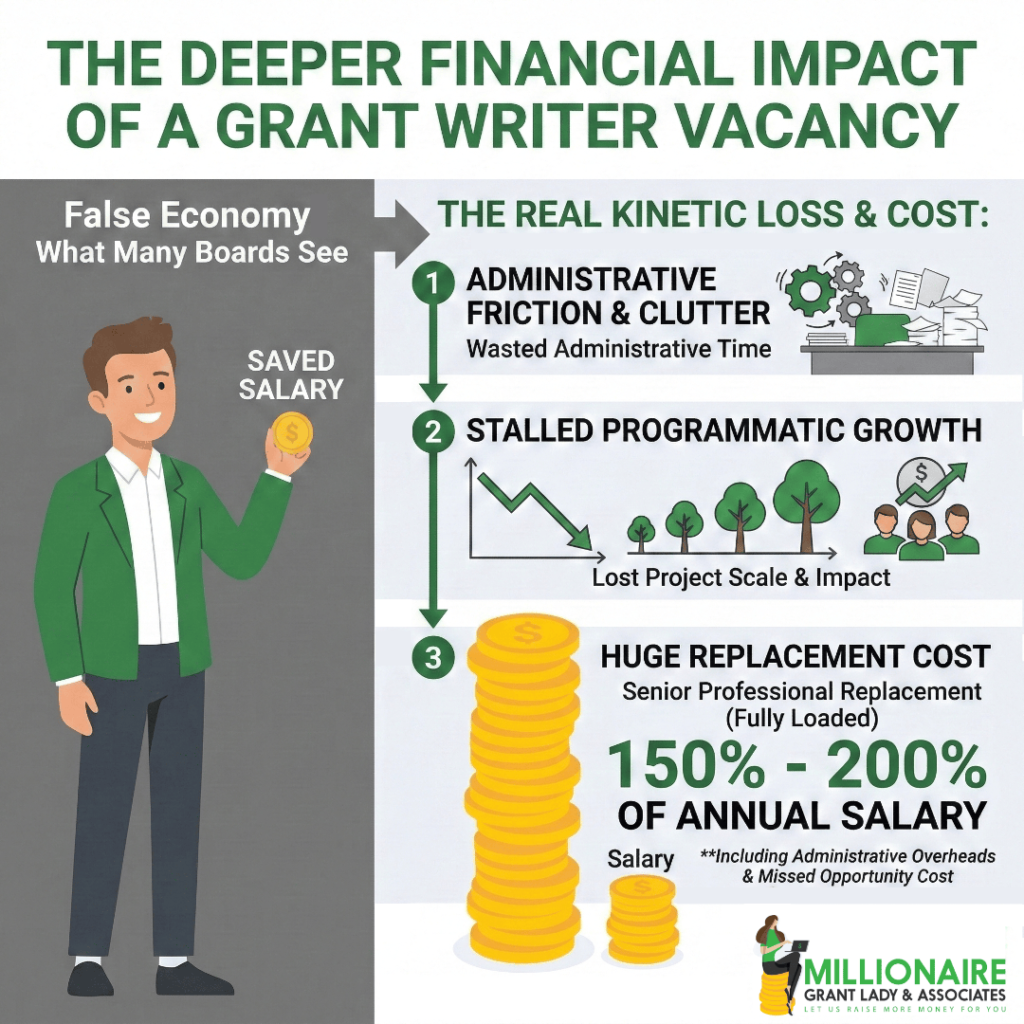
Donor retention rates often drop by as much as 10% following a key departure, as consistent messaging, submitting applications, and reports often get missed. Without expert oversight to bridge the gap, nonprofits lose the “institutional memory” required to navigate complex funder relationships.
| Turnover Cost Component | Impact Description | Estimated Value (USD) |
| Direct Recruitment | Agency fees and job postings | $15,000 – $25,000 |
| Onboarding & Training | Senior staff time and materials | $10,000 – $15,000 |
| Lost Campaign Revenue | Interrupted appeals and retention drops | $50,000 – $70,000 |
| Knowledge Loss | Data fragmentation and relationship decay | $30,000 – $40,000 |
| Total Impact | Combined cost per specialist | $127,650 |
Stewardship Continuity Model: A Strategic Grant Funding Stabilizer
The Stewardship Continuity Model is a month to month strategic intervention that ensures the lifecycle of grant research, writing, and reporting remains a seamless system despite personnel shifts. This model uses proprietary diagnostic tools to maintain revenue momentum and institutionalize memory, preventing the “vicious cycle” of rushed hiring.
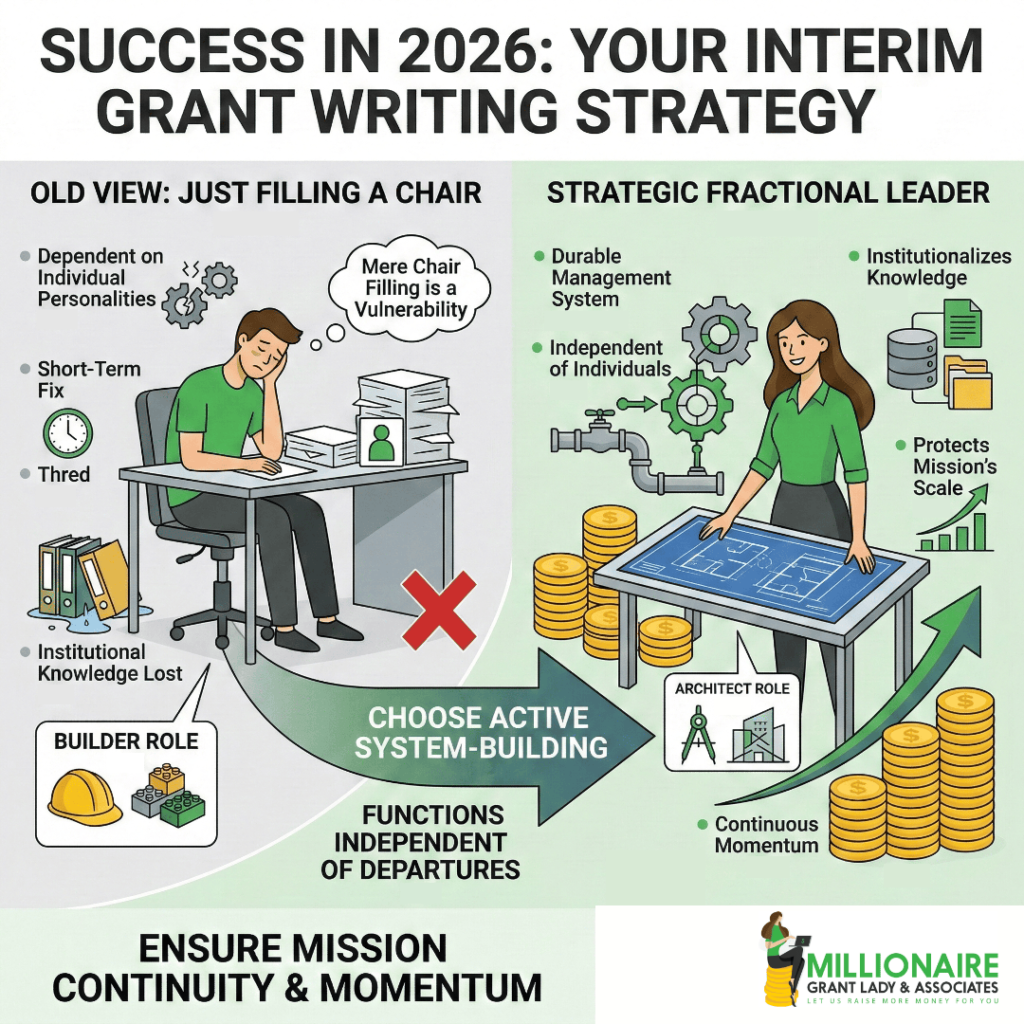
Most organizations view an interim period as a time to “hold the fort.” We view it as a time to build the fortress. By serving as your Stewardship Continuity Architect, an interim professional systematizes your entire grant writing tools environment.
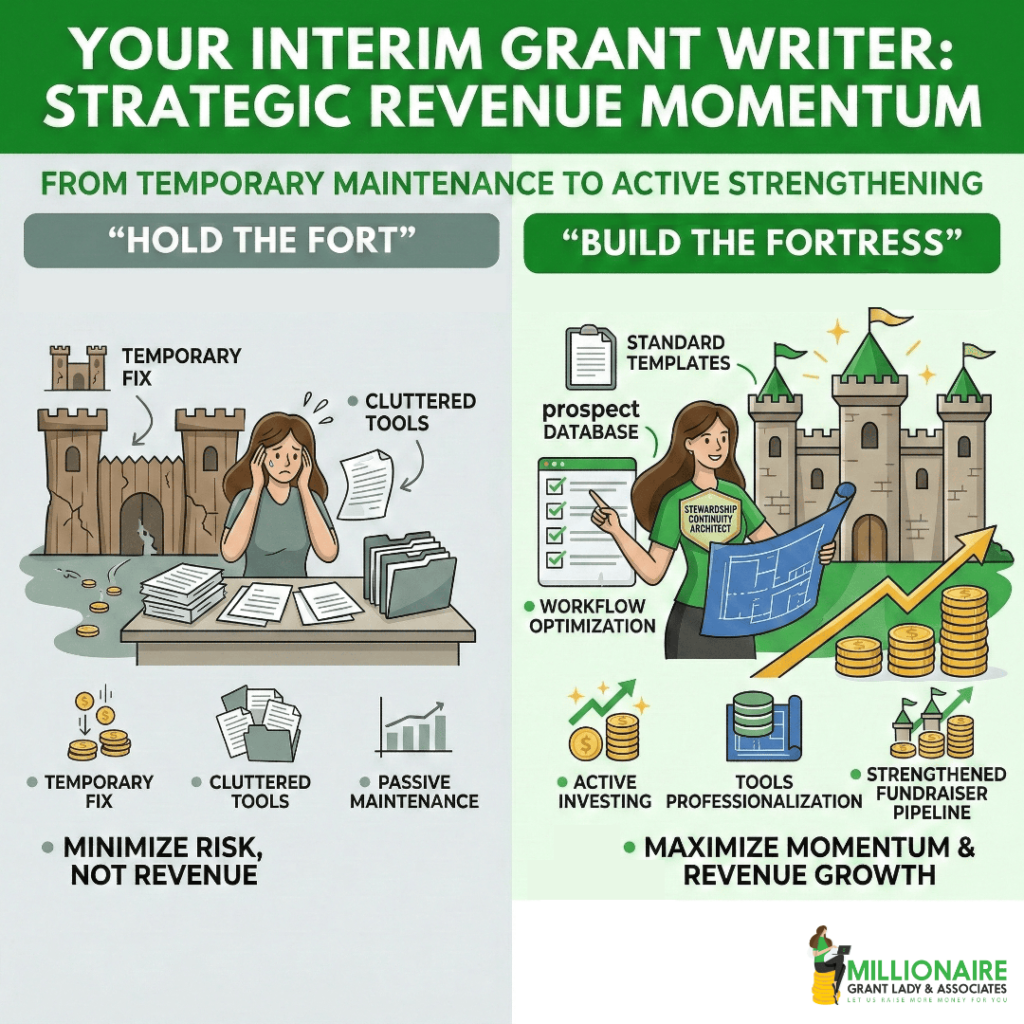
During a transition, organizations often realize that their “institutional memory” was “implicit knowledge” locked in a departing employee’s head. Our process externalizes this knowledge, creating an objective roadmap that ensures the organization remains pursuit-ready. This approach relies on our core methodologies of diagnostic readiness and rigorous alignment, which are detailed in our Executive’s Guide to Outsourced Grant Writing.
By applying the standard ROI formula for grant seeking:

We show that focusing on fewer, high-probability awards yields significantly higher net revenue than chasing low-probability “duds”. Our clients see a 93% success rate because we refuse to let the friction of turnover derail your strategic focus.
Fractional Specialists: Right-Sizing Leadership to Your Reality
Fractional leadership involves hiring a high-level specialist on a part-time basis to access senior-level expertise for a fraction of a full-time salary. This model is becoming a board-approved staffing standard in 2026, allowing organizations to pair fractional strategy with internal execution to maximize efficiency and programmatic impact.
When a grant writer leaves, the instinct for an Executive Director is to tell the remaining staff to “Google for some new grants.” In our experience, this is a recipe for stagnation. If you only apply to what is visible on the first page of Google, you are competing with every other under-resourced nonprofit in the country.We differentiate our support by moving beyond online searches. Our team uses elite, paid databases to access private entities. We find the funders who prefer to stay under the radar: those who avoid a “Contact Us” form because they prioritize strategic mission alignment over volume. The transition period is the perfect time to pivot your research toward this hidden market, ensuring your revenue does not depend on an algorithm.
Maintaining Mission Momentum: Your Succession Solution
Navigating staff turnover avoids a catastrophic loss of revenue momentum. By shifting from a reactive “temp” mindset to a strategic stewardship continuity framework, your organization can capture its institutional memory.
Success in 2026 requires more than filling a chair. It means creating a management system that functions independently of individual personalities. You have the power to protect your mission’s scale by choosing a fractional leader who acts as an architect rather than just a builder.
Don’t let a single resignation derail years of progress. We invite you to book a call today to secure your funding opportunities. You deserve to focus on your mission, knowing your revenue engine is in expert hands. When you stabilize your strategy, you do more than survive turnover — you increase nonprofit funding and feel like a million bucks.
FAQ: Managing Interim Grant Transitions
What is the most immediate risk when a grant writer quits?
Access to funder portals and institutional memory is the most pressing risk. Organizations should prioritize securing logins (SAM.gov, Grants.gov, individual foundations) and conducting a succession audit of the next 45 days of deadlines before pursuing new prospects.
Can AI replace an interim grant writer during a vacancy?
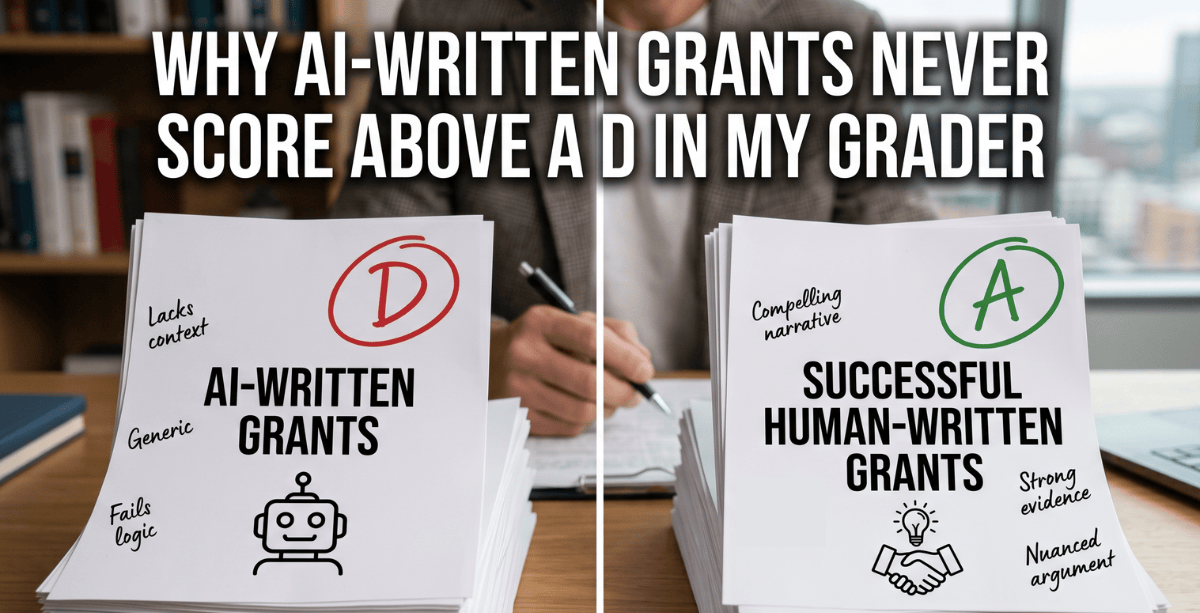
AI excels at RFP parsing and drafting initial paragraphs, but AI lacks the strategic perspective required to win in the most competitive situations. We recommend using AI as a co-pilot for drafting speed while relying on a fractional leader to handle analysis, cohesiveness, strategy, and implementation.
What is a “fractional” grant writer?
A fractional grant writer provides high-level strategic oversight and tailored grant proposal development on a retainer basis. Unlike a traditional temp, they take ownership of the results and help build internal capacity that lasts beyond their engagement.
Ready to stop researching and start winning grants?
You’ve read the strategy. Now let someone who’s won over $131 million put it to work for your organization. Our Total Grants Management service takes less than 2 hours of your staff time per month.
A call is free, takes 15 minutes, and you’ll leave knowing exactly what’s possible for your nonprofit.
Book Your Grant Game Plan → See our track record firstGet Your Free Nonprofit Grant Calendar Template
Stop scrambling before deadlines. This template tracks application windows, board meetings, and reporting due dates in one place.
No spam. Unsubscribe anytime. We respect your inbox.