

Outsourced grant writing services are specialized consulting partnerships that provide nonprofit organizations with executive-level grant strategy, prospect research, and technical proposal development on a variable-cost basis. This model converts payroll overhead into an ROI-driven investment, scaling organizational capacity without the long-term risk of in-house staff turnover.
At a Glance
- Core Strategy: Transitioning to fractional leadership.
- ROI Impact: Reducing executive administrative burden to <2 hours per month.
- Risk Mitigation: Eliminating the financial hemorrhage of 18-month turnover cycles.
- Proprietary Mastery: Leveraging the Attractiveness Quotient™ to audit fundability before submission.
I’ve raised over $125 million in grant funding. If there’s one truth most nonprofit boards overlook, it’s this: grant acquisition is a variable outcome that shouldn’t be a payroll liability. Many nonprofits are trapped in a cycle of hiring generalists who lack the strategic depth to achieve meaningful results. They don’t realize that fundability is a measurable metric that must be reviewed before you submit a proposal. And just when you think they might be getting it… they leave.
If you’re feeling the weight of the nonprofit starvation cycle, you aren’t alone. It’s exhausting to manage the revolving door of fundraising staff, where the average development director tenure has compressed to a staggering 16–18 months. You’re likely searching for outsourced grant writing services because you need relief from the burden, not another W-2 employee to manage.
You don’t have to figure out grants alone.
With over $131 million in grants won, we know what funders are looking for. Our system lets you manage the grant writing process in less than 2 hours per month so you can focus on your mission, not your proposals. A free call takes 15 minutes and will show you exactly where to start.
Book Your Grant Game Plan → See what we’ve won for organizations like yoursYou need a fractional grant writer, a professional who provides high-level strategy without the overhead of a full-time hire.
This guide is an executive-level deep dive into variable-growth models and the cost of vacancy that’s quietly hemorrhaging your budget. We’ll look at how to use grant readiness assessments and ethical compliance to protect your institutional memory and secure a 10x ROI.
By the end of this playbook, you’ll have a roadmap to reconsider your long-term grant approach. I’ll show you how to shift from a scarcity mindset to strategic abundance, allowing you to manage millions in funding in less than two hours a month. Let’s start with why modern nonprofits are finally pivoting from hiring to partnering.
Why Modern Nonprofits Are Pivoting from Hiring Grant Writers to Partnering
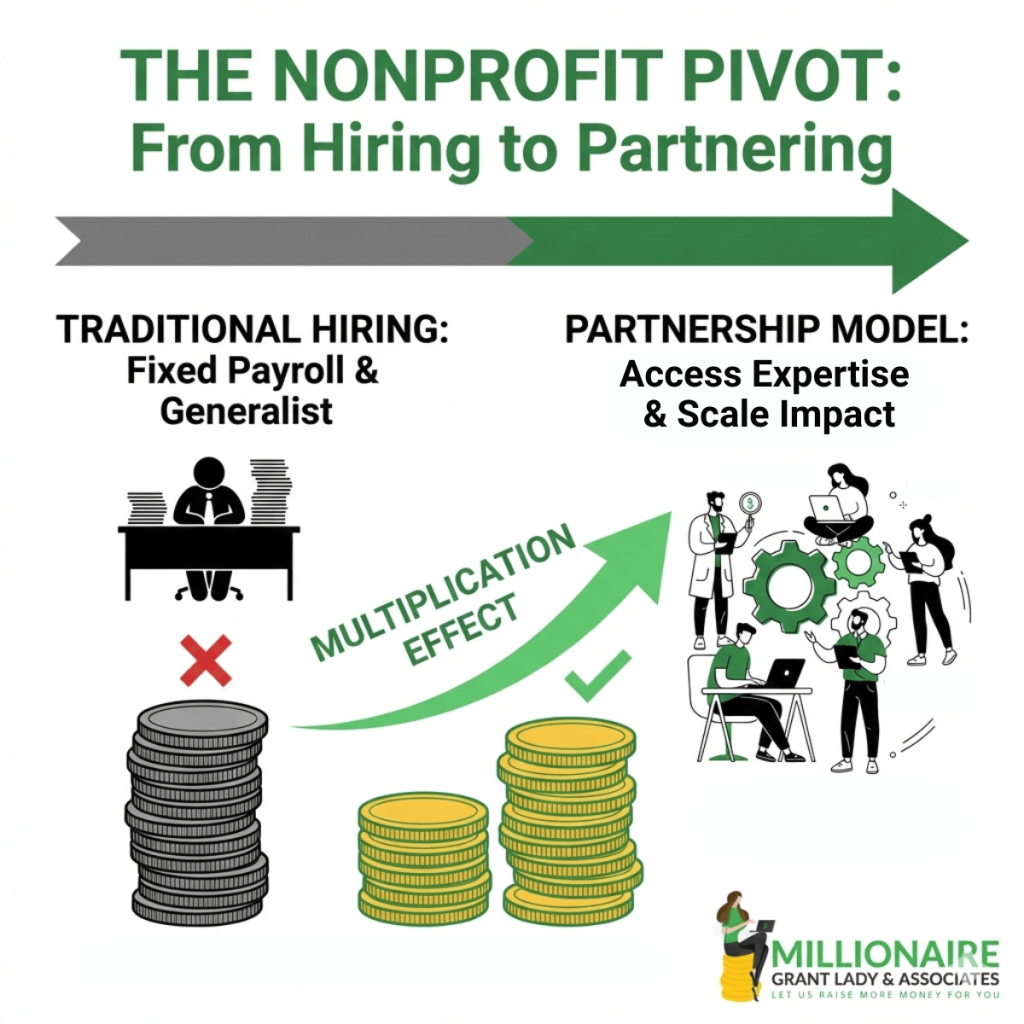
Fractional grant leadership is a strategic model where a nonprofit partners with an external expert firm to manage the full grant lifecycle, rather than assuming the payroll and recruiting liability of a full-time employee.
In my work as a grant reviewer and CFRE-certified expert, I’ve seen boards make the same mistake repeatedly: they treat grant seeking as a clerical task. They hire a person when they should hire for a system.
Traditional hiring models force you to gamble on a generalist who may lack the specific technical expertise required for complex federal narratives. By pivoting to a partnership model, you access a team-based multiplication effect. One expert handles prospect research while another focuses on proposals, etc.
This shift provides administrative ease and a rejection of the nonprofit starvation cycle. This cycle occurs when donors demand low overhead, forcing nonprofits to under-invest in the very systems needed to raise money.
By using outsourced grant writing services, you reclassify high-level expertise from an administrative burden to a variable service expense. You scale your mission without inflating your permanent payroll.
Escaping the Starvation Cycle
The nonprofit starvation cycle is a debilitating feedback loop where underinvestment in organizational infrastructure leads to operational fragility; transitioning to an outsourced model converts administrative overhead into an ROI-driven investment.
Boards often mistake a vacancy for a “saving.” Data shows that persistent vacancies now plague 75% of nonprofits, effectively stalling revenue growth. When you hire in-house, you’re paying for attendance, not output.
You’re also absorbing the burdened cost of payroll taxes, health insurance, and specialized software licenses. In contrast, an outsourced expert model provides immediate grant writing ROI by focusing project time on resource mobilization.
| Cost Category | In-House Employee Model | Outsourced Expert Model |
|---|---|---|
| Recruitment Cost | \~$16,000 per hire | $0 (Instant access) |
| Training/Onboarding | \~$8,000 \+ 6 month ramp-up | $0 (Day 1 expertise) |
| Benefits/Taxes | \+20-50% of Base Salary | $0 (Included in fee) |
| Technology Stack | $3,000+ (Laptops, Licenses) | $0 (Provided by firm) |
| Strategic Level | Tactical / Execution | Strategic / Total Grants Management |
Crucially, for organizations pursuing federal support, this transition is supported by federal law. Under 2 CFR 200.460, proposal costs are classified as indirect costs. This means you cannot write a line item for a “commission” into a federal budget if you want to pass an audit. By operating on a flat-fee, variable-cost basis, we protect you from the regulatory risks of unethical “percentage-based” compensation.
Protecting Nonprofit Institutional Memory in an Era of Rapid Turnover
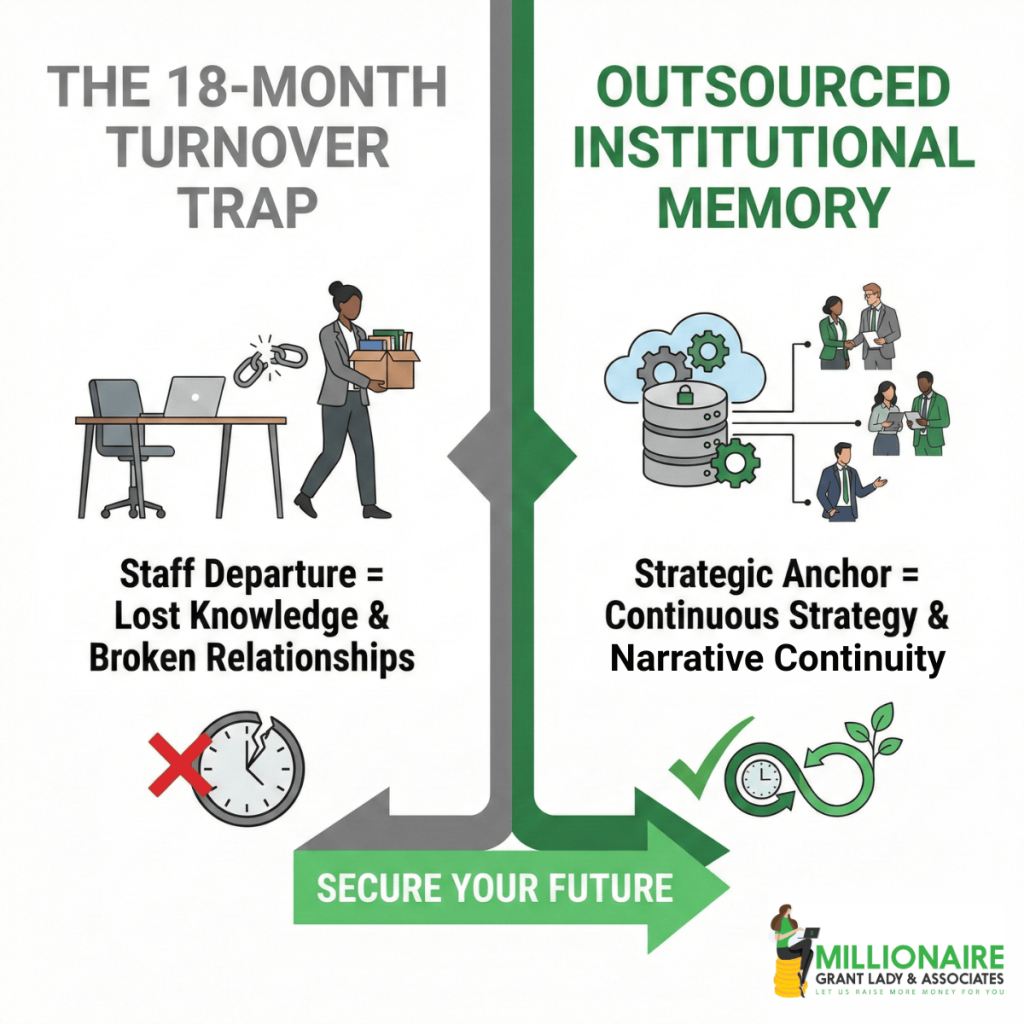
Nonprofit turnover averages 16 to 18 months, which causes broken promises to funders and severs the 24-month grant lifecycle; outsourcing provides institutional permanence by ensuring strategy remains intact even if individual staff members depart.
The 18-month turnover trap is the single greatest threat to your funding pipeline.
Because the grant lifecycle can span 12 to 24 months, a staff departure at month 18 severs the cycle, right as it should yield fruit. This “stop-start” cycle erodes your credibility with foundations, who look for stability as a primary indicator of organizational health.
When a writer departs, they take more than their laptop. They take the institutional memory of why certain narratives were framed a specific way. Using interim grant support or long-term outsourcing ensures the system outlasts the person. We serve as your strategic anchor, maintaining the narrative history and ensuring no reporting deadline is ever missed.
Millionaire Grant Lady Methodology: Manage Millions in Under 2 Hours a Month
The Millionaire Grant Lady Methodology is a proprietary, three-pillar framework—Attractiveness Quotient™, Area of Focus™, and Core Cultivation™—that productizes the grant process to maximize fundability while minimizing executive time commitment.
Most executives think winning grants is about “better writing.” It isn’t. Foundations buy impact, fiscal health, and governance. We begin every partnership by calculating your Attractiveness Quotient™. By auditing 15 indicators, from board-giving to 990 transparency, we identify the structural weaknesses that lead reviewers to a “no.”
We then apply our Area of Focus™ methodology to dismantle the “spray and pray” pathology. Chasing every open RFP is a recipe for burnout. We enforce a strict alignment audit: if the funding opportunities don’t match your strategic mission by at least 90%, it’s a “No-Go.” This ensures each proposal focuses on high-probability, high-ROI submissions.
We reject the transactional nature of cold submissions. By implementing “Zero-Ask” touchpoints and using professional networks, we move your organization from the 10-20% success rate of cold grant applications to the 40-90% range of established partnerships.
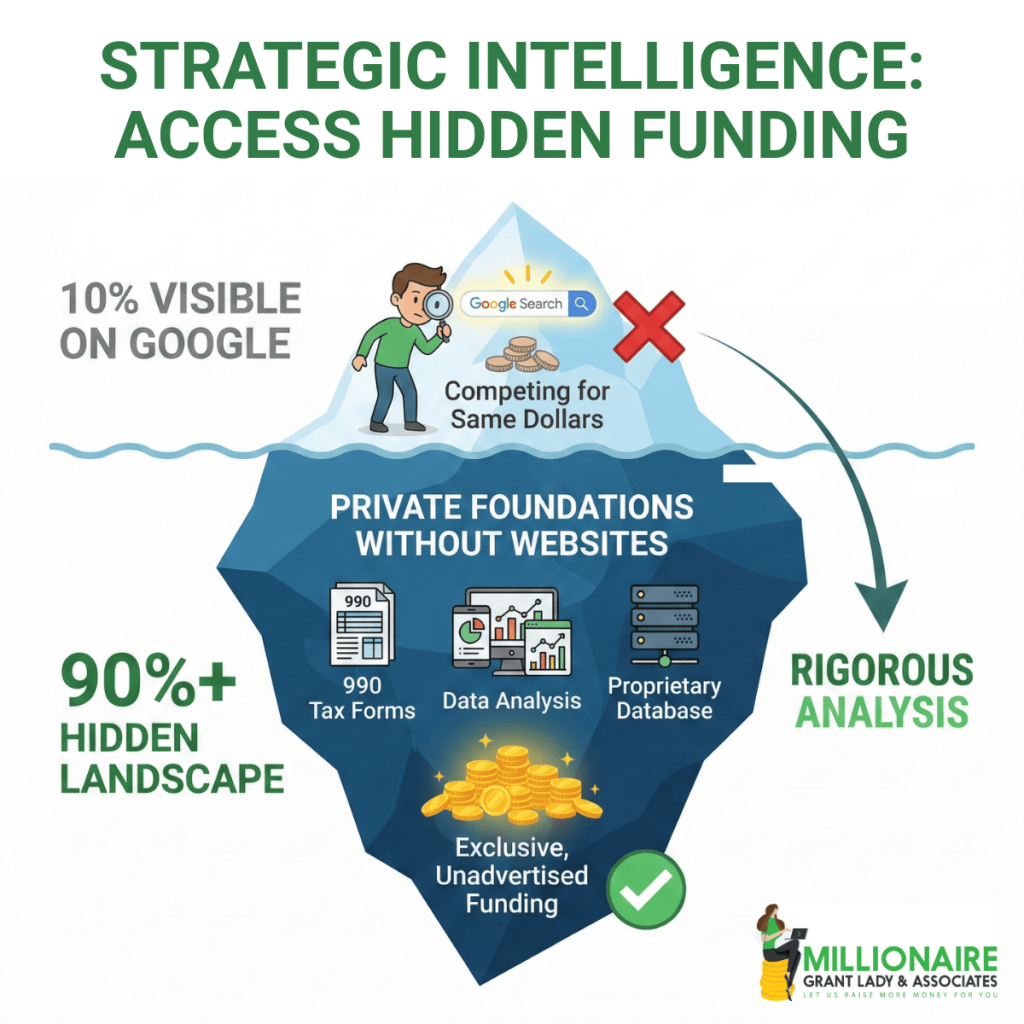
Strategic Intelligence: Accessing Funding Not Found on Google
Strategic prospect research involves mining proprietary databases to uncover the “invisible market” of private foundations that do not maintain public websites or advertise funding cycles.
If your current grant writer is relying on Google, you’re competing with thousands for the same visible dollars.
Elite outsourced grant writing services operate in the “hidden landscape.” Over 90% of foundations in the U.S. do not have a website; they are effectively invisible to amateurs embarking on grant research. If you can see the foundation, you can’t see foundation grants.
We access this market through rigorous analysis, identifying mandates for distribution that must be met regardless of public visibility.
This isn’t about finding names; it’s about funder anthropology. We analyze the stock market correlation, knowing that foundations are legally mandated to disburse ~5% of their investment assets annually.
Philanthropic Anthropology: The S&P 500 Connection
Philanthropic anthropology is the study of funder behavior through macroeconomic indicators, specifically the causal relationship between stock market performance and the mandatory disbursement requirement for foundations.
Following a strong market year, foundations are often desperate to offload cash to meet IRS quotas. Having a “shovel-ready” project during these windows is the difference between a standard gift and a transformational award.
We don’t apply for grants. We time your asks. If you’re pursuing a major capital campaign, we look at the rolling three-year market average to predict desperation windows where foundations must offload cash.
By aligning your mission-driven initiatives with these mandates, we move you from a position of “asking for help” to a position of “offering an investment opportunity” that helps the funder meet their own legal obligations.
Risk Management & Ethics: Why Compliance is Your Best ROI Strategy
Ethical compliance in fundraising is a non-negotiable professional mandate that prohibits commission-based pay and percentage-based compensation to ensure the preservation of donor intent and minimize regulatory audit risk.
In the nonprofit sector, “percentage-based compensation” is the ultimate litmus test for professionalism. You might find a freelancer willing to “take a cut,” but this is a red flag for both ethical and legal failure.
The GPA Code of Ethics and the AFP Code of Ethical Standards explicitly prohibit commissions because they create a conflict of interest, prioritizing the writer’s wallet over your mission.
For those seeking federal grant help, the stakes are legal. Under 2 CFR 200.460, grant proposal costs are indirect administrative expenses. If you attempt to pay a commission out of a federal award, you’re likely violating cost principles, risking a full audit finding and the repayment of the entire grant.
We protect our clients from this existential risk by operating on a transparent project or retainer basis. Our goal isn’t to gamble on your future, but to engineer it. By placing ethics over shortcuts, we ensure that when you win, the funding is secure and ethical.
Tired Reviewer Doctrine: Grant Writing that Wins the 20-Second Audit
The tired reviewer doctrine is a psychological writing framework that prioritizes visual skimmability and radical clarity to overcome the cognitive fatigue of grant officers who are predisposed to find a reason for rejection.
Most grant consultancies treat the reviewer like a scholar. We treat them like human beings. I’ve served as a grant reviewer, and I know your reviewer could read your application at 4:30 PM on a Friday. They’re on their 30th file, and they are looking for a reason to say “no.” If your narrative is a dense “wall of text” filled with academic jargon, you’ve already lost.
We apply the “Grandma Test” to every sentence: if a grandmother wouldn’t understand the impact of your program within five seconds, we rewrite it.
Why? Because we KNOW the application process. We move beyond the technical specs to sell the result. By using bolded metrics and bulleted lists for any group of three or more items, we ensure your proven track record hits them in the eyes before they yawn.
ROI of Strategic Distance: Outsourced Grant Writing Service
The transition from a payroll liability to a growth investment is more than a budget adjustment; it is a fundamental shift in your organization’s revenue architecture. By applying the Attractiveness Quotient™ and the tired reviewer doctrine, you move beyond the “spray and pray” desperation of the nonprofit starvation cycle.
We’ve proven through over $125 million in secured funding that the most effective way to scale is to use outsourced grant writing services that decouple your mission from the volatility of staff turnover.
Your path forward is clear. Stop managing the process and start measuring your return on investment (ROI). Your first step is a diagnostic audit of your readiness, identifying the structural gaps that lead reviewers to say “no” before they’ve even finished the first page. Grants are manageable when you stop hiring for a person and start hiring for a system.
We protect your reputation and your funds by adhering to the highest ethical standards, ensuring every proposal reflects your true impact. You don’t have to do this alone.
You can continue the 18-month cycle of burnout, or you can build an infrastructure that outlasts your tenure. If you’re ready to increase your funding and reduce your staff burden, you’ll feel like a million bucks, and you might just raise that much, too. Schedule a consultation today to assess your organization’s fundability.
Ready to stop researching and start winning grants?
You’ve read the strategy. Now let someone who’s won over $131 million put it to work for your organization. Our Total Grants Management service takes less than 2 hours of your staff time per month.
A call is free, takes 15 minutes, and you’ll leave knowing exactly what’s possible for your nonprofit.
Book Your Grant Game Plan → See our track record firstGet Your Free Nonprofit Grant Calendar Template
Stop scrambling before deadlines. This template tracks application windows, board meetings, and reporting due dates in one place.
No spam. Unsubscribe anytime. We respect your inbox.